agentflows
Coded, multi-step agent workflows against real repositories, with a board that shows what is happening while it is still happening. Under active development, and the interesting parts are the constraints.
Most agent frameworks let a model decide what happens next. That is the feature, and it is also the reason you cannot run the same chain twice and get the same shape of work. agentflows takes the opposite position: the workflow is a Python function, it decides sequencing, retries and acceptance, and the agents do the work inside one bounded step. Nothing about the graph is chosen by a model at runtime.
It is a working application, not a paper. Seven of the ten phases are built, tested and running against real repositories on my machine. It is not finished, it is not public yet, and this page is as much an invitation to argue with the design as it is a description of it.
Where it is right now
| Phase | What it is | State |
|---|---|---|
| P0-P2 | Skeleton, configuration and catalogue resolution, the SQLite trace | built |
| P3 | Two runtime adapters behind one contract | built |
| P4 | The runtime: the step primitive, checks, write boundary, budgets | built |
| P5 | Four coded workflows and the CLI | built |
| P6 | Worktree isolation and the human merge gate | built |
| P7 | The JSON API and the board, layout C | built |
| P8 | Two more layouts and the waterfall | next |
| P9 | The operator layer, so an assistant can drive the CLI | after that |
406 tests, none of which make a live model call: the adapter tests run against recorded streams, because a test that spent money on every run is a test you eventually stop running.
What it actually does
You point it at one or more repositories in a config.yaml, name which agents that workspace
uses, and run a chain:
af run plan_build "add a /health endpoint that reports DB connectivity" -w health-app
af ask architect ./PRD.md          # one-shot: no repo, no diff, no write boundary
af serve                           # the board, on 127.0.0.1:8848
Four chains ship today, one file each:
workflow         chain                                       agents
ask              ask(agent) -> record                        -
investigate_fix  investigate(scout) -> fix(engineer) ->      scout, engineer
                 test -> repair(engineer)*
plan_build       plan(architect) -> build(engineer) -> test  architect, engineer
                 -> fix(engineer)* -> commit
review_change    capture -> review(code-reviewer) -> record  code-reviewer
Adding a workflow is adding a file. There is no registry to edit, so there is none to forget to edit.
The decisions I would defend
Everything below started as an argument with myself, and each one is written down in the architecture with the reason attached.
- A step starts as
failed, and only a clean exit flips it. A step that died mid-flight therefore reads correctly without anything having had to notice that it died. The reverse default gives you a trace full of work that never finished, marked green. - The write boundary is enforced by diff, never by a tool allowlist.
bashcan rungit checkoutand a write tool can reach any path, so no capability list makes "this agent changes nothing" true. The tree is snapshotted before an agent step and compared after; anything outside that agent's declared paths is rolled back and the step fails. The snapshot keeps the bytes rather than a digest, because a digest can tell you a file was deleted and only the content can put it back. What a boundary cannot do is protect you from an agent inside it: an engineer allowed to writesrc/**is allowed to empty it. That is what the worktree is for. whyis mandatory on every step, and may not restate the name. It is the only line of intent the board, the terminal and the trace will ever show, socommit: Commit the changesis refused by the call that wrote it rather than by the person reading the board a day later.- A parse failure or a failed check re-prompts the same session. The correction names exactly what was wrong and costs one message, against an agent that still remembers the task. A cold restart throws the context away and pays for it twice.
- Two criteria settle a run, not one. Every step must have passed and the workflow's own acceptance must hold. They differ on purpose: a code step that ran a red test suite did its job perfectly, so the step succeeded while the run must not.
- A rule a reviewer would miss belongs in a guard, not a comment. One flag on one runtime silently changes which account is billed. It is refused inside both argv builders and a test asserts it never appears on a command line, because the reviewer who would catch it in a diff is the one who is not reading that diff.
One data path
Agents write to SQLite as they work, and every reader polls SQLite. Four tables, and one query is the whole read path:
select rowid, * from events where run_id = ? and rowid > ? order by rowid limit ?;The live view and the full history are that same query at a different cadence, which is why there is no push transport, no ingest endpoint and no replay path to keep in sync. The database is WAL with autocommit, so a reader sees a run's events while the run is still working and never blocks it. Files are the raw record and the database is the queryable mirror: losing the database loses nothing that cannot be rebuilt from disk.
The board
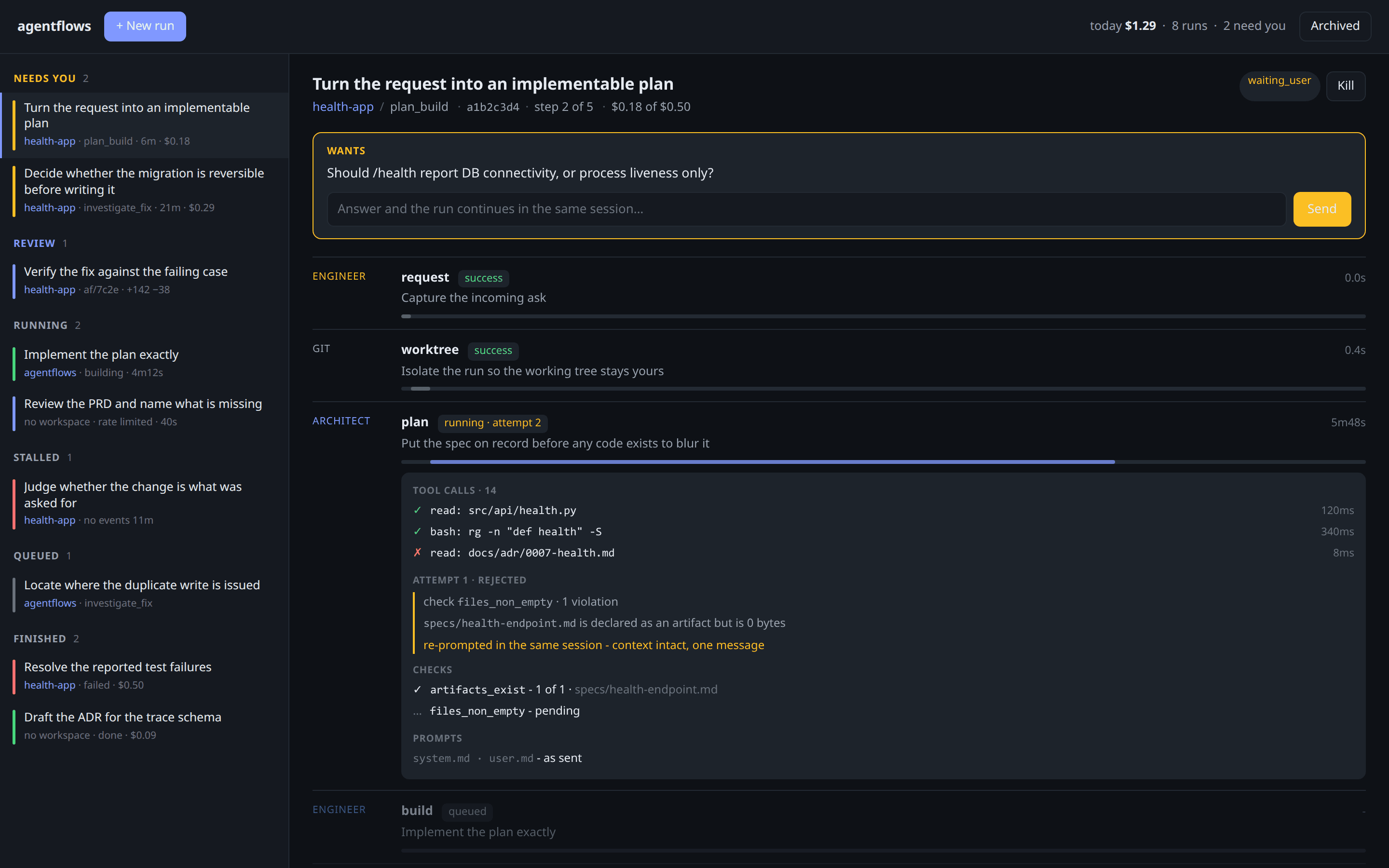
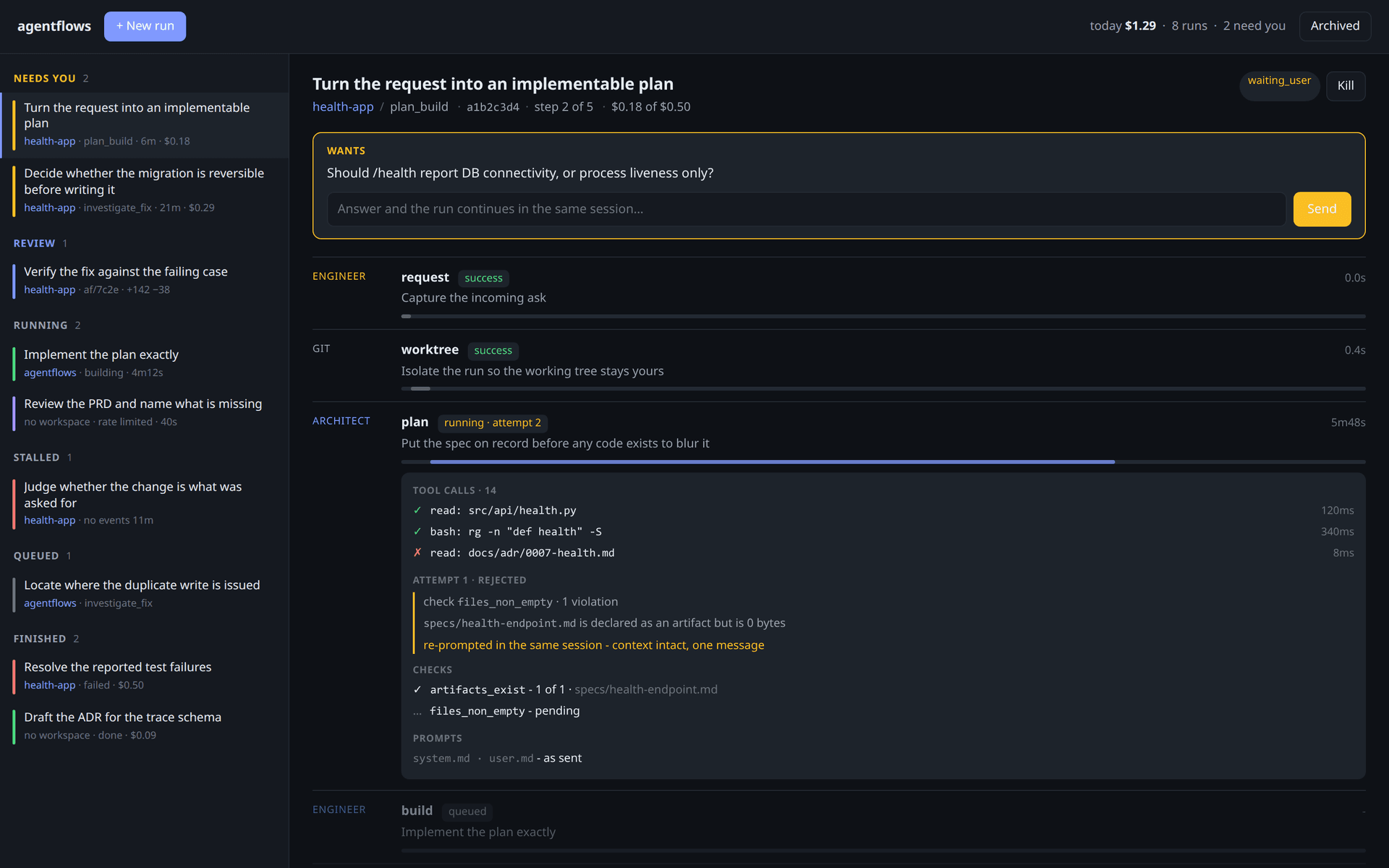
The board is one screen: a rail of runs on the left, the selected run on the right. What makes it useful is not the rendering, it is the grouping.
Lanes are what a run wants from you, not its raw state - Needs you, Review, Running,
Stalled, Queued, Finished. rate_limited sits under Running, because on a subscription plan
that is the cost of the plan and not an error. A card leads with the current step's why
rather than the workflow name, which is the payoff for why being mandatory.
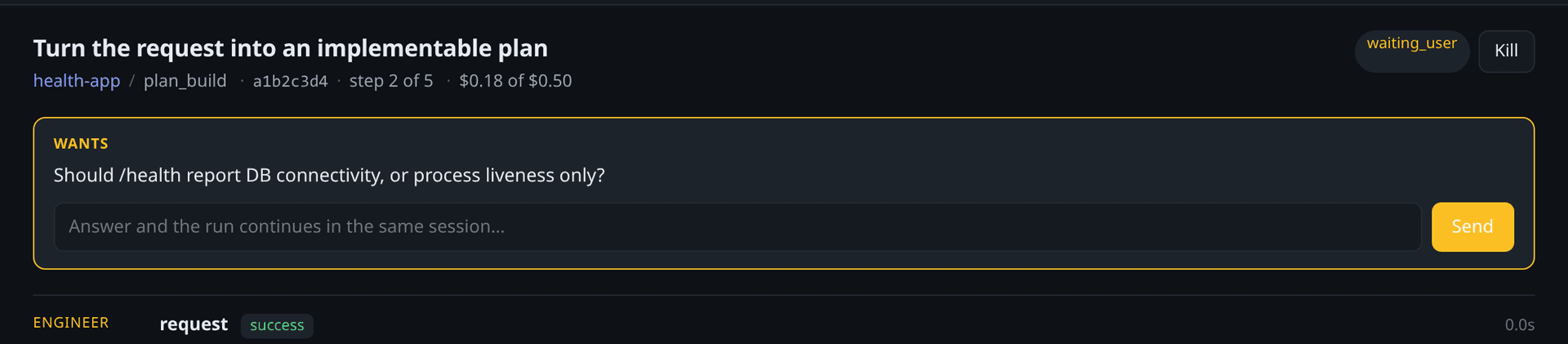
A run that needs an answer shows its question with an input box next to it. Answering resumes the same agent session instead of starting a new one.
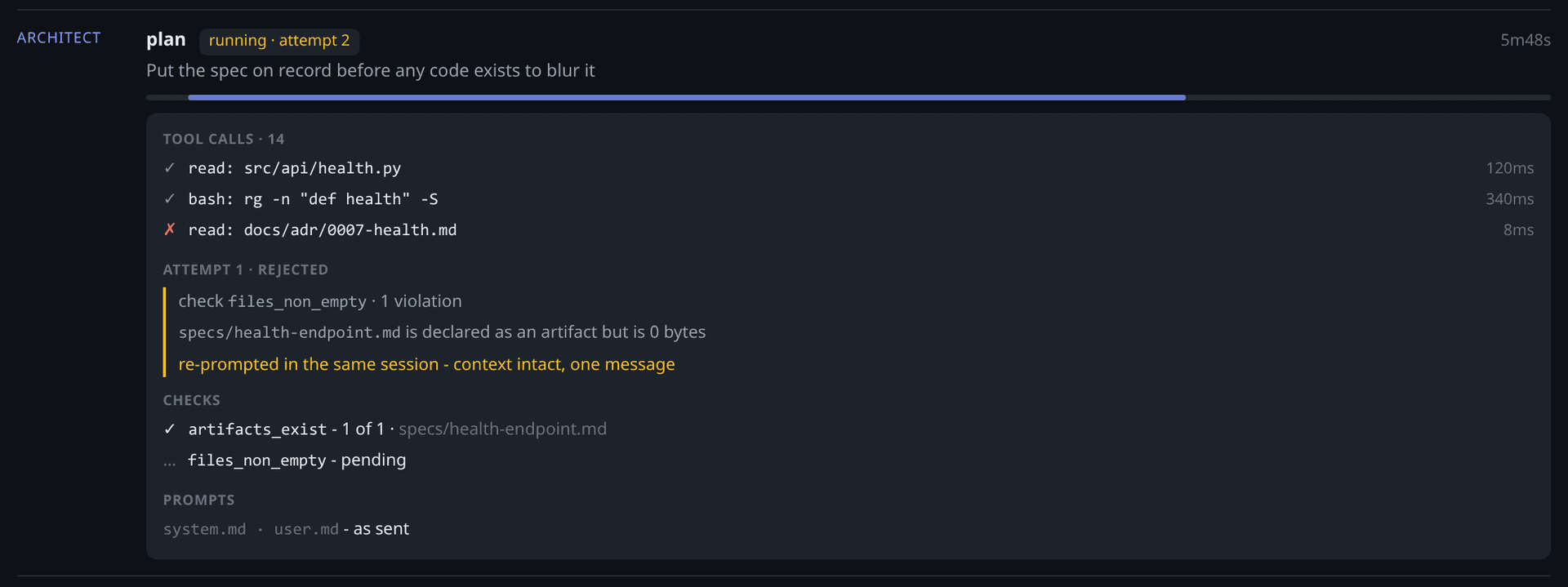
An expanded agent step shows its tool calls, the exact prompts that were sent, the handoff as accepted, and every check with per-item results - including which attempt a correction happened on and what the violation said. A check that verified nothing is not green: "verified nothing" must never be indistinguishable from "verified everything".
The board never spawns a process. Queueing a run writes a request file; a separate
af next claims it and executes it. One spawn path, and no daemon to supervise.
Autonomous inside, gated at the merge
A workspace can be set to worktree isolation, and then every run gets a fresh git worktree
on its own branch. The run is free to work there, and it stops at review instead of done.
af review 20260823-101010-a1b2c3   # the branch, the diff stat, every step's handoff
af accept 20260823-101010-a1b2c3   # records that a human looked. Merges nothing
af reject 20260823-101010-a1b2c3 "the tests were never run"
accept does not merge, and nothing in the application removes a worktree on its own. The
merge is your own git command against a branch the app will not touch. That is the line I did
not want to blur: an agent may be trusted to work unattended, and still not be trusted to put
the work on your main branch while you are not looking.
How it is built
src/agentflows/
  config.py       workspaces, rosters, defaults, and validation that collects
  trace.py        four tables, WAL, one cursor query
  runtime.py      the step primitive, the correction loop, the run directory
  checks.py       predicates run after a step, against what the handoff claims
  permissions.py  the write boundary, enforced by diff
  worktree.py     isolation and the merge gate
  cli.py          af run / ask / list / status / tail / kill / review / serve / next
  adapters/       pi on OpenRouter, claude_code on the subscription
  workflows/      coded chains, one file each - discovered, never registered
web/              the board: React, TypeScript, Tailwind, built by Vite
Python 3.12 and uv, about 7,000 lines of source against 4,900 lines of tests. Node is a
build-time dependency only: af serve serves the built bundle and answers the API from the
trace, and nothing in the run path knows Node exists.
The application is deliberately not inside the repositories it edits. An agent physically cannot modify the machinery that grades it.
What comes next
- The waterfall (P8). Steps on a time axis, one lane per owner, a rejected attempt visible as its own segment. Duration and gaps should read as shape rather than as numbers - that is what makes the observability claim true instead of decorative. It is a rearrangement of the same five components, not a rewrite, and the API already returns the per-attempt timings that nothing yet renders.
- The operator layer (P9). A markdown document, not a subsystem, so an assistant can drive the CLI: translate the request into a sharper prompt, pick the workflow, launch, poll, report what failed verbatim. It does no workflow work itself.
- A teams engine, deferred on purpose. A budget-terminated conversation among several personas is not a chain - there is no step boundary to hang a handoff on - so it needs its own engine rather than a flag on this one. It would reuse the trace, the personas and the budgets, and share nothing else.
- Runtime-authored plans, which is the one thing on this list that argues with the premise. Today the Python function is the plan, and the step list exists before anything runs. The deferred version lets an agent emit a step list at runtime, validates it against the roster and persists it before a single step executes - a new authoring path in front of the same executor, rather than a model steering the run as it goes. Worth building only once several workflows exist and a shape recurs that none of them fits.
- Crash resume, Docker isolation, a cross-run cost ledger. All captured, none scheduled. Worktrees plus the write boundary already cover the realistic failure modes.
Why this might matter to you
If you run engineering teams, the question underneath all of this is not "can an agent write the code". It is: what would have to be true before you let one run unattended against a repository that matters. My answer so far is four things - a chain that a person wrote, a boundary that is checked rather than promised, a trace that is honest about failure, and a human at the merge - and the rest is implementation.
The repository is private for now, licensed AGPL-3.0 and intended to go public once the license protection is worth having. I would like to hear from you if any of this is close to something you are doing:
- You have tried to put agents on real work and hit the trust boundary rather than the capability one. I would like to know where yours sits.
- You think one of the decisions above is wrong. Tell me which and why - each of them is a trade I made deliberately, and being wrong in private is not better than being corrected in public.
- You want to talk about this kind of platform work in a hiring, advisory or collaboration context.
Email me or find me on LinkedIn.
Screenshots on this page show layout C of the board, from the design the shipped board was built to. They will be replaced with captures of the running application as the remaining layouts land. agentflows is licensed under the GNU Affero General Public License v3.